Kategorie: Wall Works

  • Gill Gatfield, ALTER EGO

    Duration: December 1, 2021 – April 9, 2022

    Visible daily until midnight, 2nd floor opening hours: Wed. – Fri. 14-18 or by appointment

    On the occasion of her first solo presentation in Berlin, Alter Ego, Aotearoa New Zealand born artist Gill Gatfield conceived a project in two chapters – a large scale crystal-glass sculpture and a public space virtual reality installation – which talk and expand towards the human being. Renowned for her minimal, conceptual and abstract sculptures, and for her inclusive public monuments, Gatfield’s project relates to the public, the architecture, structures and infrastructures of the city, the area of Berlin Mitte and the L40 building, home of the Kunstverein am Rosa-Luxemburg-Platz.

    Inside the foyer of the L40, The Muses vibrate, float and emerge from the space and reverberate meanings. The installation centers the eye on three monumental glass figures, shining outward from halos of soft white shaded edges, lightly held to the ground by an over one-hundred year old pine timber beam. They are shaped as ‘I’, as pure ancestral forms, as deeply rooted and recognised syntagms, as totemic figures.

    The sculptural elements – translucent glass planes, blackened timber and wall, measured space, fine lines and internal curves, create unexpected volume and speak about light and shadow, form and material, material as matter and language, ephemeral nuances and reflections. The language of the artist – her process, her system of references – takes shape into monochromatic transparent paradigms, suggesting fluidity and transitional moments in a realm located between sign, signifier and signified.

    The Muses occupy a transient space yet they convey a transcript about form, shape, proportions and abstract figures that stand as guardians, protectors of meanings and visions. They tell stories through the material, stories that anchor on to the material itself and on the substance, the matter that constitutes the observable, the shadows and the light, as elements of a discursive approach. The Muses seem to decipher society’s paradigms through a magic lens by being, by echoing through phenomena. Hence the work is perceived as resolving complex, philosophical and sociological expressions by bending the matter and reasoning about atavistic shapes. Ultimately, The Muses reclaim our attention, enclose social and interactional paths, invite us to touch them, to feel, perceive them; they guide us through narrations whence we relate, they suggest an alternate path of intentionality, of meaning-making.

    As the doors open on the second floor, the Siren awaits. The piece reveals itself in the form of an elongated ‘I’, red, crisp, bright. She stands as an Island, a siren who sings without sound and charms the eye, guarding our origin and destination coordinates.

    Another ancestral form is to be seen in the sculpture Aroha (meaning love in Māori), a molten stone ‘X’, an emblematic shape, the witness of the process of connection, it marks a place, a message, anchored to the Earth’s core.

    The second chapter of Gatfield’s Alter Ego lies beyond the L40 walls. Native Tongue XR is the extended reality alter ego of a sculpture carved from the heartwood of a giant tree buried in Aotearoa New Zealand before the last Ice Age. The analogue twin is a public artwork, a taonga (treasure), a totem steeped in its own place, another continent half a world away. The virtual reality sculpture, to be presented in the public green space between Almstadt- and Rosa-Luxemburg-Straße in mid-January, stands in simpatico with The Muses. It is a fourth I-figure, a sculptural volume described digitally in air, yet lifelike and perceivable, a spirit figure, proof of life, bringing the past into the present tense. Through the virtual rendering of Native Tongue XR, Gill Gatfield translates and transforms further her production, demonstrating her finesse of the artistic process, media and materials perception. At the threshold of reality and digital stimulation, the sensation of synaesthesia occurs, completing the Alter Ego journey into a multi-layered, poetic, philosophical world.

    – Chiara Valci Mazzara

    Gill Gatfield (1963) transforms ancient and futuristic materials and media into otherworldly abstract forms, sparking connections between nature, time, humanity and place. Her work has won international awards, commissions for place-making art, and is held in public and private collections in NZ, Australia, USA and Europe. International exhibitions include Sculpture by Sea Perth Australia 2021, VSC Alumx USA 2020, Venice Architecture Biennale 2018, A18 New York, Chicago Expo 2018, SCAPE Public Art 2017, and Sculpture by Sea Aarhus Denmark 2015. Gill Gatfield holds an MA(Hons) Auckland University. Awards and recognition include sole Juror, WomanMade International Open Chicago 2015, residency and solo exhibition Kvindemuseet/KØN Denmark 2015, international CODAaward 2017 Public Art Landscape Award, New Zealand Woman of Influence award 2018, Sculpture Fellowship and residency Vermont Studio Centre 2019, Creative NZ Art Grants 2019 and 2020, CODAworx Creative Revolutionary 2020.

    Native Tongue XR supported by: Spark Foundation NZ and Creative New Zealand Toi Aotearoa

  • Warren Neidich, Parthenon Marble Recoded: The Phantom as Other

    31.7. und 4.8.21, jeweils 18-20h performativer Vortrag im Foyer: Warren Neidich, Performing the Parthenon Marbles Recoded

    The Parthenon Marbles Recoded: The Phantom as Other ist eine neue, karnevaleske Neonlicht-Wandinstallation des in Berlin lebenden, amerikanischen Künstlers Warren Neidich. Sie antizipiert eine beunruhigende Zukunft, indem sie heute darüber nachdenkt, was aus unserer Zivilisation im Moment der so genannten ‚Singularität‘ zukünftig werden könnte. Wie erstmals von John von Neumann formuliert, ist diese ‚Singularität ‘ das Ergebnis kontinuierlicher technologischer Beschleunigung.  Von Neumann ging davon aus, dass Maschinenintelligenz eines Tages den kritischen Punkt erreichen würde (den er als ‚Singularität‘ bezeichnete), an dem sie die menschliche Intelligenz überholen würde. Ihre künftige Fähigkeit, sich selbst zu replizieren und zu kodieren, würde sie zur herrschenden Intelligenz auf dem Planeten Erde machen, was die menschliche Spezies in eine existenzielle Katastrophe stürzen würde.

    Diese Vorahnung bildet den Ausgangspunkt der Skulptur The Parthenon Marbles Recoded: The Phantom as Other.  Diese imaginiert ein transhistorisches Science-Fiction-Szenario, das sich aus einer klassischen griechischen Skulptur – den ‚Elgin Marbles‘ – und der Frage ihrer Restitution, sowie dem Phänomen der Phantom-Gliedmaßen und außerkörperlichen Erfahrung zusammensetzt. Diese disparaten Elemente sind durch die Schaltkreise eines komplexen künstlichen neuronalen Netzwerks verbunden, das mit einer Reihe von künstlichen Intelligenzen und der Singularität verschränkt ist. The Parthenon Marbles Recoded: The Phantom as Other spekuliert auf eine Zukunft, in der das Spektrale zu einem entscheidenden kritischen Instrument wird. Dabei bezieht sich der Künstler auf Jacques Derridas Konzept des ‚Gespenstes‘, wie er es in seinem Buch „Marx‘ Gespenster“ entwickelt: Eine Entität, die im Zentrum der Dialektik des Materialismus steht. Die beiden Begriffe ‚Phantom‘ und ‚Gespenst‘ verschränken sich zur vitalen Kraft eines subversiven Anderen, das an den äußersten Rändern der gesellschaftlichen Ordnung existiert. Im Unterschied zu jenen Kräften, die für gewöhnlich Gruppenzugehörigkeiten generieren, wird dieses ‚Andere‘ ebenjene Verbindungen bestimmen, die das künstliche neuronale Netzwerk bilden, welches wiederum die in diesem Werk antizipierte Superintelligenz und Singularität modelliert. Kurz gesagt fungiert das ‚Phantom‘ hier als eine Metapher für ‚Othering‘: Das Andere wird zu einem kritischen Instrument. Spuk, das Unheimliche (und ihre vielfältigen Aneignungen in der zeitgenössischen Kultur) dienen auf diese Weise nicht mehr nur der Beschreibung des reanimierten Leichnams oder Zombies, sondern werden zu einem analytischen und politischen Werkzeug, das den Status von Natur und Wissen als per se phantasmatisch zu entlarven vermag. Phantome werden dergestalt zu Metaphern für Queering und Dekolonisierung, die einen Prozess des Nichtwissens anstoßen und die Produktion dessen anregen, was Fred Moten und Stephano Harney die ‚Undercommons‘ nennen.

    Die Installation wird im Rahmen der Ausstellung Activist Neuroaesthtics vom 1.Mai – 30.September 2021 gezeigt.

    Die Installation wurde unterstützt von:


  • Mark Fridvalszki, Forward and Up!

    Ab 17.2.21 bis 18.4.21 ist die Installation im Foyer des Kunstvereins 24h am Tag zu sehen.

    Mark Fridvalszki beschäftigt sich mit der sinnlichen Materialität aufgegebener oder gescheiterter Utopien der Moderne. Normalerweise mischt der Künstler dazu experimentell verschiedenste Materialien wie Tapeten, gefundene und hergestellte Objekte, Digitaldruck sowie andere Drucktechniken und führt sie in raumfüllenden Collagen zusammen. Sein künstlerisches Programm kann als archäo-futurologisch bezeichnet werden, d.h. es geht um die Auseinandersetzung mit den Resten vergessener Utopien, den kulturellen Sedimenten unserer verlorenen kollektiven Zukunft So erklärt sich auch der Titel Forward and Up! seiner neuen Installation im Foyer des Kunstvereins.
    Wie in allen seinen neuen Arbeiten stehen auch hier Kunst und kühn-experimentelle Populärkultur neben der Intensität musikalischer Subkulturen im Fokus. Dahinter verbirgt sich eine gewisse Sehnsucht nach den strahlend, optimistischen Visionen vor allem der 60er und 70er Jahre des 20. Jhdt.s inklusive der damaligen Exkurse in Psychedelia und Acid mit allen dazugehörigen improvisatorischen und kreativen Lebenshaltungen. Sie erinnern uns an die Möglichkeit die Welt aus anderer Perspektive zu betrachten.

    Mark Fridvalszki *1981 Budapest, lebt und arbeitet in Berlin  

    Review art-in-berlin

    The site specific installation in the foyer of the Kunstverein will be visable 24/7 from 17.2.21 to 18.4.21. Mark Fridvalszki’s artworks deal with the sensual materiality of failed modernist visions. Usually the artist mixes a wide variety of media, such as wallpaper, found and manufactured objects, digital printing and other printing techniques and combines them in all embracing collages. His artistic program can be described as archaeo-futurological, meaning that it deals with the remains of forgotten utopias, the cultural sediments of our lost collective future. This gives an idea of how to interpret the title of his new installation Forward and Up!
    As in all of his new works, the focus here is on art and boldly experimental popular culture alongside the intensity of musical subcultures. Behind this is a certain longing for the radiant, optimistic visions, especially of the 60s and 70s of the 20th century, including the excursions into psychedelia and acid with all the associated improvisational and creative attitudes. They remind us of the opportunity to see the world from a different perspective.

    Mark Fridvalszki  *1981 Budapest, lives and works in Berlin

  • Elodie Seguin, hall painting

    Elodie Seguin, hall painting

    15.9.–31.12.19
    Zugänglich während der Bürozeiten im Haus.

    Es ist immer eine Herausforderung Kunstwerke in den öffentlichen Raum zu bringen. Besonders wenn man im Bereich der erweiterten Malerei arbeitet. Für unsere jüngste Wandarbeit hat Elodie Seguin einen einzigartigen Ansatz definiert, der die Beziehung zwischen mehreren gemalten Objekten sowie ihre Organisation innerhalb und ihre Beziehung zum gegebenen Ausstellungsraum untersucht. Der Effekt ist Farbe als evokatives Volumen. Je nachdem von welchem Standpunkt aus sie betrachtet wird, ergeben sich jeweils unterschiedliche Effekte. In seinen reduktionistischen Tendenzen zeigt Seguins Werk eine offensichtliche Verwandtschaft mit der minimalistischen Tradition. Dennoch bleibt immer eine spontane, experimentelle Dimension in ihrem Prozess, d.h. die Installation gewinnt erst während des Malens selbst mittels Versuch und Irrtum ihre endgültige Form.

    It’s always a challenge to introduce your artwork into the public space. Particularly so when you work within the field of expanded painting. For our recent wall work Elodie Seguin has defined a unique approach which explores the relationship between several painted objects as well as their organization within and their relation to the given exhibition space. The effect is color as an evocative volume – depending on how it is confronted. In its reductivist tendencies Seguin’s work reveals an obvious affinity to the minimalist tradition. Nevertheless there invariably remains a spontaneous, experimental dimension to her process. The means that the installation will only take it’s definite shape by trial and error during the painting itself.

  • Irène Hug, Repräsentation

    Weit entfernt von der cleanen Schriftkunst amerikanischer Minimalisten oder Konzeptkünstler, konfrontiert uns Irène Hug mit ihren Botschaften in grellen Leuchtschriften, Objekten, Installationen und Fotografien. Hug bearbeitet und verwertet die typografischen Formen von Wegweisern, Logos und Reklameslogans, die weltweit urbane Räume überziehen. Mit den Techniken der Appropriation, der Montage, des Zitats und der Retusche reagiert sie auf die vorgefundenen Materialien, Situationen oder stereotypen Erscheinungsbilder, deren Bedeutung sie mittels pointierter und zugleich komplexer gestalterischer Eingriffe verändert und kommentiert.

    Für den Kunstverein hat sie eine neue Arbeit entwickelt, die mit subtilem Witz unsere Verstrickungen in omnipräsenten Konsumismus hinterfragt und uns auffordert, gleichsam hinter den Oberflächen, der wahren Bedeutung von Dingen und Worten auf den Grund zu gehen.

    Der Katalog Reading Pictures (Deutsch/Englisch) erscheint bei Fantôme, ISBN 978-3-940999-45-0
    Die Arbeit ist 24h/Tag sichtbar und kann zu üblichen Bürozeiten besucht werden.

    Far from sober artworks of American minimalists or conceptual artists involving written language, Irène Hug confronts us with her messages in glaring neon signs, objects, installations and photographs. Hug utilises and manipulates the typographic components of signposts, logos and advertising slogans that cover urban spaces worldwide. Using techniques of appropriation, montage, citation, and retouching she reacts to found materials, situations or stereotypical images, commenting on and changing their meaning using pointed but complex artistic interventions.

    The artist has conceived a new work for the Kunstverein that questions our entanglement in omnipresent consumerism, and challenges us to get, behind the surfaces, as it were, to the bottom of the true meaning of things and words.

    The catalogue Reading Pictures (German/English) is published by Fantôme, ISBN 978-3-940999-45-0
    The artwork is visible 24/24 and can be visited during usual office hours.

  • Monique van Genderen, Shila Khatami, Ingo Meller, To Start a Painting
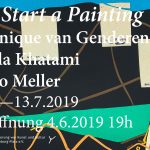
    Monique van Genderen, Shila Khatami, Ingo Meller, To Start a Painting

    5.6.—13.7.2019

    Letze Woche 9.-13.7.19 – Sommerpause 22.7. – 22.8.19

    Öffnungszeiten: Mi-Fr 14 – 18 h und auf Anfrage

    Ungegenständliche Malerei ist kein einheitliches Produktionsfeld. Dessen ungeachtet, stehen regelmäßig Fragen im Vordergrund, die im Bewusstsein ihres historischen, sozialen und institutionellen Rahmens formuliert werden. Parameter aktueller Formen sind in vielen Fällen Überlegungen, die Produktion und Material genauso reflektieren wie den Ort ihrer Präsentation. To Start a Painting bringt mit Monique van Genderen, Shila Khatami und Ingo Meller drei der interessantesten Positionen zusammen.

    Die kanadisch-amerikanische Malerin Monique van Genderen hat eigens für die Ausstellung eine neue, wandfüllende Arbeit entwickelt, die ausschließlich aus retro-reflektierenden Folien besteht, wie sie im Straßenverkehr verwendet werden. In ihr behauptet sie, dass Bild auch Menschen seien und – muss man unweigerlich folgern – auch so behandelt werden wollen. In gleicher Weise bedient sich die Berliner Malerin Shila Khatami einer technischen Oberfläche. Ihre raumgreifende Installation aus Metallplatten mit Auto- und Metallschutzlacken verweist auf die Werkstatt als Produktionsort, während die malerische Komposition Motive aus dem Vokabular der Stadtaneignung wie Graffiti oder Tags aufgreift und sie zu Formen aus den Traditionen und Methoden der Avantgarden des 20. Jahrhunderts in Beziehung setzt. Beide Künstlerinnen loten Elemente des Raums und der Illusion im Rahmen der Abstraktion aus. Man kann sagen, dass sie es der Oberfläche und dem Material erlaubten, eigenständig die Bildebene zu verhandeln. Ähnliches gilt für Ingo Meller. Ein beträchtlicher Teil der traditionellen Leinwand, auf der Meller seine blockartigen, gelegentlich auch verwischten Farbsetzungen aufträgt, bleibt unbemalt. Sie ist Farbe und Träger zugleich, verschmilzt beinahe mit der Wand und verbindet sich mit den satten Ölfarben der streng analytischen Farbgesten des Künstlers. Diese Entwürfe greifen weit über bloße Ästhetik hinaus, denn bei aller Strenge entwickeln Farbe und Material ein Eigenleben und sind deshalb nicht ganz ungefährlich.

    Mit freundlicher Unterstützung der rotec GmbH, Berlin

    English:

    Opening hours Wed – Fri 2 – 6 pm and upon request

    Non-representational painting is not a unified field of production. Nonetheless, regular attention is paid to painterly questions formulated in the light of its historical, social and institutional framework. In many cases, parameters of current forms are considerations that reflect production and material just as much as the location of presentation. To Start a Painting brings together three of the most interesting positions in this field: Monique van Genderen, Shila Khatami and Ingo Meller.

    The Canadian-American painter Monique van Genderen has developed a new, wall-filling work for the exhibition, which consists exclusively of retro-reflective foils commonly used in traffic. In it she asserts that images are also human and – one must inevitably conclude – want to be treated like that. In the same way, the Berlin painter Shila Khatami uses a technical surface. Her expansive installation of metal panels with car and metal protective lacquers refers to the workshop as a production location, while the painterly composition picks up motifs from the vocabulary of city re-appropriation such as graffiti or tags and relates them to forms of the traditions and methods of the avant-gardes of the 20th century. Both artists explore elements of space and illusion in the context of abstraction. One can say that they allow the surfaces and materials to negotiate the image plane almost on their own. The same applies to Ingo Meller. A considerable part of the traditional canvas, on which Meller applies his blocky, occasionally blurred color compositions, remains unpainted. At one and the same time, it blends with the wall and merges with the rich oil colors of the artist’s strictly analytical color gestures. These designs go far beyond mere aesthetics, because despite their severity, color and material have a life of their own and are therefore not entirely harmless.

    With friendly support of rotec GmbH, Berlin

  • Babette Kleijn, Casting the Runes

    1.2.–15.4.2019

    During her residency at AiR Berlin Alexanderplatz (ABA) last year, Rotterdam based artist Babette Kleijn explored different forms of ironwork applied on and in monumental buildings like the Volksbühne on Rosa-Luxemburg-Platz. The repetitive character as well as the ornamental aesthetics of the iron railings inspired her to discover the language of this material by learning the practice of iron forging herself from scratch. The new wallwork Kleijn created for the Foyer of the Kunstverein on Rosa-Luxemburg-Platz ist the first application of this technique in her art. In Casting the Runes the artist aimes to establish a balance between script and ornamentation. Drawing from the strong resonating presence of written language and symbolism that runs through the history of humanity, Kleijn is driven by the rich interpretative potential that we humans possess. It is this creative and interpretive power that Kleijn attempts to trigger in the viewer though her work.

    This project was established in collaboration with AiR Berlin Alexanderplatz and generous support by the Mondriaan Fund (NL).

    Während ihres Aufenthalts bei AiR Berlin Alexanderplatz (ABA) im vergangenen Jahr erforschte die in Rotterdam lebende Künstlerin Babette Kleijn verschiedene Formen der Eisenverarbeitung, die sich in Berlin überall an monumentalen Gebäuden finden – so auch an der Volksbühne am Rosa-Luxemburg-Platz. Der sich wiederholende Charakter sowie die dekorative Ästhetik der Eisengeländer regten sie an, die Sprache dieses Materials für sich zu entdecken. Konsequent begann die Künstlerin die Praxis des Eisenschmiedens von Grund auf zu erlernen. Die neue Wandarbeit, die Kleijn für das Foyer des Kunstvereins am Rosa-Luxemburg-Platz entwickelt hat, ist die erste Anwendung dieser Technik in ihrer Arbeit. In Casting the Runes etabliert die Künstlerin ein Gleichgewicht zwischen Schrift und Ornamentik. Ausgehend von der stark resonanten Präsenz von Schriftsprache und Symbolik, die sich durch die Geschichte der Menschheit zieht, wird Kleijn durch das reiche Interpretationspotential angetrieben, das in menschlichen Artefakten liegt. Es ist diese schöpferische und interpretierende Kraft, die Kleijn durch ihre Arbeit beim Betrachter ansprechen möchte.

    Dieses Projekt entstand in Zusammenarbeit mit AiR Berlin Alexanderplatz und wird Mondriaan Fonds (NL) unterstützt.


  • Karina Nimmerfall, A NEW ROOM OF ONE’S OWN

    10.11.18 – 18.1.19
    Öffnungszeiten Mi-Fr  14-18 h und jederzeit auf Anfrage

    Wir machen zwischen dem 24.12.2018 und 4.1.2019 Winterpause.

    18.1.2019. 19:30 Vortrag von Irene Nierhaus und Gespräch mit der Künstlerin


  • Mies in Berlin, Flux of Experience

    Mies in Berlin, Flux of Experience


    Eröffnung 28.4.2018. 13–18 h
    Dauer: 26.4.–23.6.2018, verlängert bis 13.7.2018

    Maja Wirkus & Eric Pries Wallwork


  • Felix Kultau, Idyllwild

    kuratiert von Nina Mielcarczyk
    11.3.–23.3.2018
    Eröffnung 10.3.2018 19h

    Wir laden Sie herzlich zur Ausstellung Idyllwild von Felix Kultau ein. Die Arbeiten des Künstlers werden in Form eines umfassenden Ausstellungsdisplays aus neuen sowie älteren Arbeiten gezeigt. Dieses erweitern wird eine neue Installation im Foyer des Gebäudes. Kongenial ergänzend liest der Schriftsteller Leif Randt am 22.03.18 um 20h in der Präsentation neue Texte.

    „Aufgewachsen an der Grenze zum größten Nationalpark Kaliforniens, mit Air Berlin nach Europa, BA am Goldsmith,MA am Städel, das Glück gefunden in Belleville, das Glück verloren in Moabit, dann zurück nach Idyllwild – smoking the rocks.“ (Leif Randt)

    Das Ausgangsmaterial für die Arbeiten Kultaus sind in verschiedenen Kontexten benutzte, markierte, beklebte und verkratzte Türen von Metallspinden. Mutmaßungen über ihren ursprünglichen Kontext weisen in verschiedene Richtungen, erinnern an Konflikte Pubertierender aus amerikanischen High-School Filmen oder der militärischen Gleichschaltung des Privaten. Kultau reagiert auf das Äußere dieser Spinde und erweitert es um ästhetische Vermutungen eines vermeintlichen Dahinter. Seine visuellen Überformungen funktionieren als ein Ineinanderblenden der Zeichen exklusiver Milieus und den Spuren privater Erzählungen. Eine strukturelle Abnutzung und Verwertung der Subkulturen oder des attraktiven Unbekannten.

    (EN)
    „Growing up on the border to the largest national park in California, with Air Berlin to Europe, BA at Goldsmith, MA at Städel,happiness found in Belleville, happiness lost in Moabit, then back to Idyllwild – smoking the rocks.“ (Leif Randt)

    Starting point for Felix Kultau’s works are used metal locker doors – marked, glued, and scratched – derived from various origins. Kultau responds to the exterior of these lockers and expands it to the aesthetic conjectures of a supposed behind. His visual formations function as an interconnection of the signs of exclusive milieus and the traces of private narratives. A structural erosion and recovery of subcultures or the attractive unknown.