





Mateusz Choróbski, P.OST, exhibition views. © Tomasz Koszewnik
Der Kunstverein am Rosa-Luxemburg-Platz freut sich, P.OST, die erste institutionelle Einzelausstellung des polnischen Künstlers Mateusz Choróbski in Deutschland, zu präsentieren. Speziell für den Kunstverein entwickelt, versammelt die Ausstellung Klang, Video-, Licht- und skulpturale Installationen, um über Erinnerung, Transformation und der vielschichtigen Identität des Rosa- Luxemburg-Platzes nachzudenken.
Choróbskis Arbeiten erkunden das Spannungsevrhältnis zwischen Nostalgie und Erinnerung, hinterfragen die Tendenz, die Vergangenheit zu idealisieren, und fragen, wie Nostalgie verstanden werden kann – als Sentimentalität, als Erbe oder als Missverständnis. So verweist bereits der Titel P.OST zugleich auf den verschwundenen OST – Schriftzug der Volksbühne und auf die Frage, was „nach dem Osten“ kommt.
Inspiriert von der architektonischen und kulturellen Geschichte des Rosa-Luxemburg-Platzes – besondere von Hans Poelzigs Entwürfen für das Babylon-Kino – verwandelt Choróbski den Ausstellungsraum in eine Bühne aus Spuren, Schatten und Fragmenten urbanen Umfelds. Seine Arbeit spannt einen weiten Bogen über Video, Installation, Performance, Klang und Skulptur. Häufig setzt der Künstler den menschlichen Körper neben und in Architekturen und untersucht, was bleibt, wenn soziale, politische oder materielle Systeme an ihre Grenzen gelangen – verfallene modernistische Gebäude, die Schuld(en)lasten oder der verletzliche Körper in Ruhe. Diese Überreste werden Ausgangspunkte, um über Verletzlichkeit, Resilienz und sich stetig ändernde kulturelle Narrative nachzudenken.
Mit gefundenen Glasobjekten, zu neuen Formen verschmolzen, verwandelt er Licht in ein Gefäß für Geschichte und Erinnerung. Dafür nutzt er eine komplexe Technologie, die Licht von Zeit und Ort entkoppelt und es in der Ausstellung neu einsetzt – so wird Licht aus entfernten Orten oder Zeiten in der Ausstellung wieder sichtbar und erfahrbar.
Gleich beim Betreten des Gebäudes begegnen Besucher*innen einem Türgriff, gegossen aus eingeschmolzenen polnischen Ein-Grosz-Münzen, modelliert nach Poelzigs historischen Entwürfen. Eine Klanginstallation – ein gelooptes Einatmen – erfüllt den Eingangskorridor und verwandelt die Schwelle in eine Zone erhöhter Wahrnehmung, die physische Berührung mit einem subtilen Hinweis auf Atem und Erwartung verbindet.
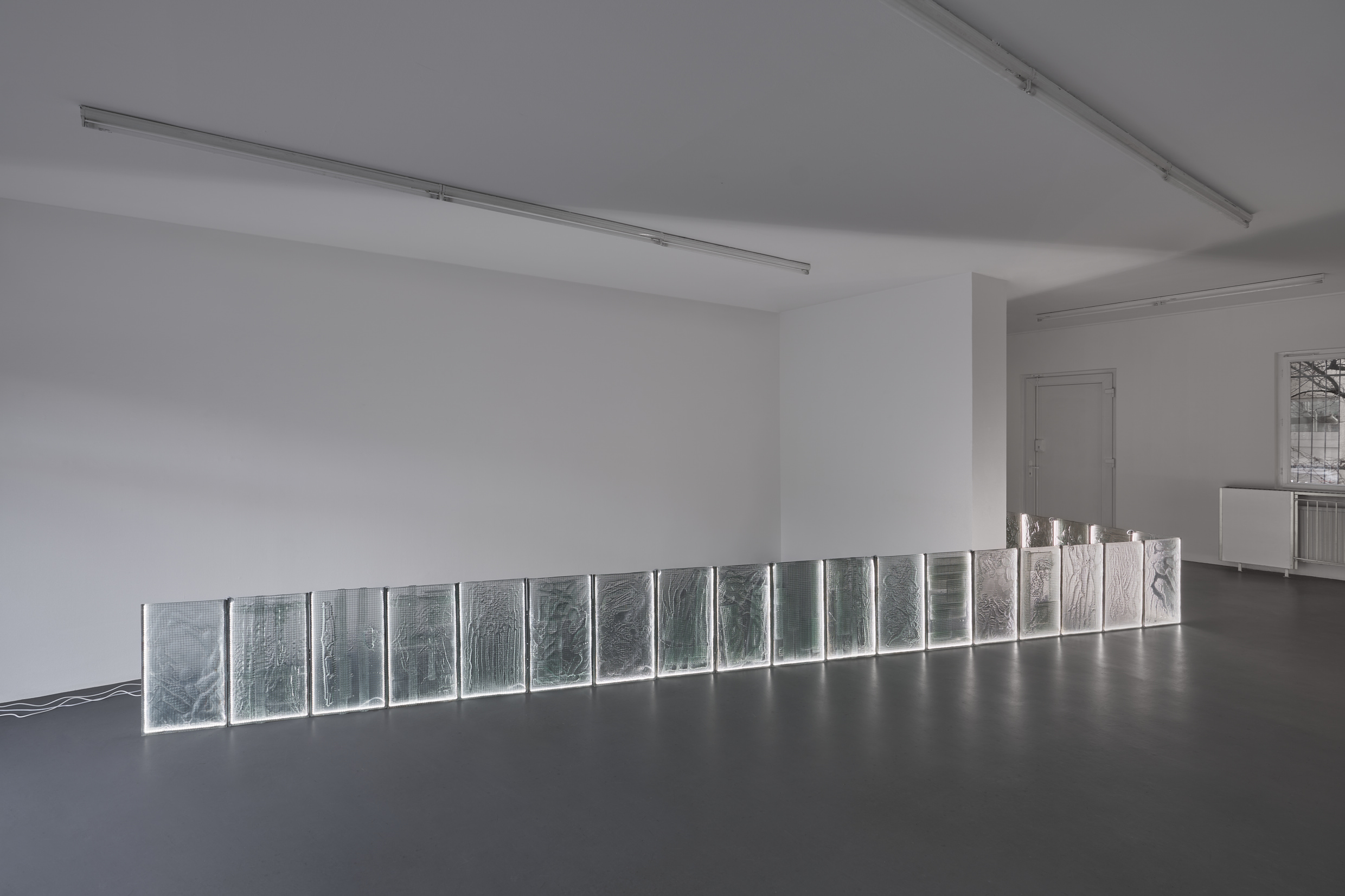
Im ersten Galerieraum führt eine zehn Meter lange Linie aus eingeschmolzenen Drahtglasplatten, beleuchtet von versteckten LEDs, exakt das Licht wieder ein, das am Vortag auf dem Rosa-Luxemburg-Platz aufgezeichnet wurde. Die unregelmäßigen, organischen Oberflächen tragen Spuren von Zeit und Atmosphäre in sich, spiegeln die wechselnden Bedingungen draußen wider und laden dazu ein, über Erinnerung, Präsenz und den Fluss der Zeit nachzudenken.
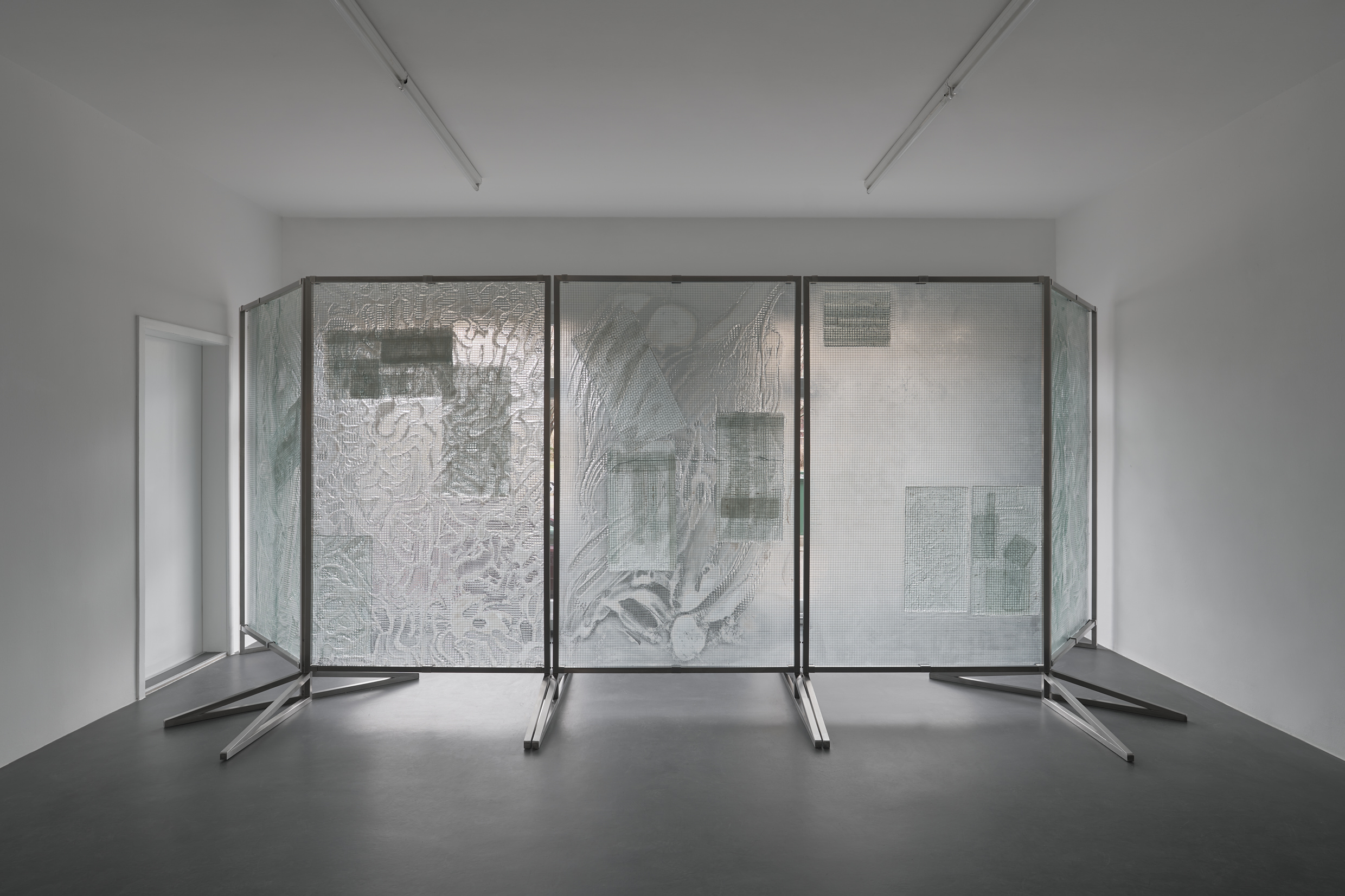
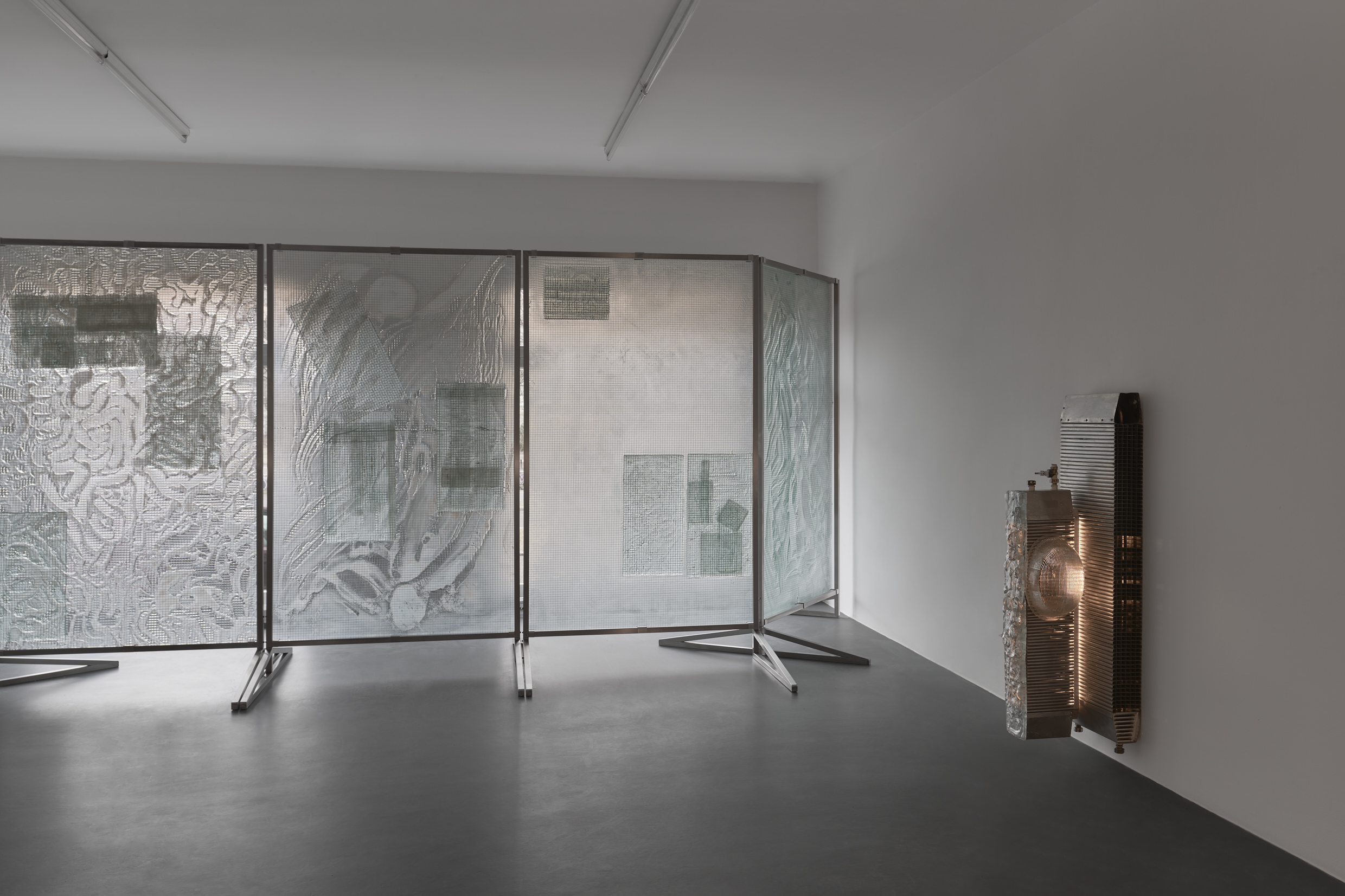
Ein zweiter Raum zeigt eine großformatige Installation aus Glasplatten, die mit Überresten früherer Arbeiten des Künstlers verschmolzen sind. Leicht über dem Boden schwebend und von der Straße aus sichtbar, wird die Arbeit zu einer Art Schattentheater: Silhouetten der Besucher*innen beleben die Oberfläche, machen das Publikum zum integralen Bestandteil der Arbeit und erweitern die Dramaturgie der Ausstellung in den öffentlichen Raum hinein.
Im abgeschlossenen Schaufenster projiziert eine Video die Hand eines Dirigenten, der Musik aus dem Stummfilm Der Golem, wie er in die Welt kam (1920)* dirigiert, für den Poelzig das Bühnenbild entworfen hat. Zur Straße hin projiziert, antwortet die Geste auf die Rhythmen und Stimmungen des Platzes und spürt seinen fortwährenden Puls von Spannung, Inszenierung und gemeinsamer Präsenz.
Die Ausstellung wurde kuratiert von Chiara Valci Mazzara und Susanne Prinz.
| Die Ausstellung wird unterstützt von der Alexander Tutsek Stiftung und ermöglicht durch durch die Stiftung für deutsch-polnische Zusammenarbeit, mit Beteiligung von OP Enheim. Sie wurde vom Adam-Mickiewicz-Institut ko-organisiert und kofinanziert vom Ministerium für Kultur und Nationales Erbe der Republik Polen. |
*„Der Golem, wie er in die Welt kam“, Partitur für kleines Orchester von Hans Landsberger, rekonstruiert und orchestriert von Richard Siedhoff, wurde uns freundlicherweise aus dem Bestand des Ries & Erler Musikverlags zur Verfügung gestellt.
[Eng] The Kunstverein am Rosa-Luxemburg-Platz is pleased to present P.OST, the first institutional solo exhibition in Germany by Polish artist Mateusz Choróbski. Developed specifically for the Kunstverein, the exhibition brings together sound, video, light, and sculptural installations that reflect on memory, transformation, and the layered identity of Rosa-Luxemburg-Platz.
Choróbski’s work explores the tension between nostalgia and memory, questioning the tendency to idealize the past and examining how nostalgia can be understood – as sentimentality, heritage, or misunderstanding. The title P.OST refers both to the vanished OST sign on the Volksbühne and to the question of what comes “after the East.” Drawing inspiration from the architectural and cultural history of Rosa-Luxemburg-Platz, particularly Hans Poelzig’s designs for the Babylon cinema, he transforms the gallery into a stage built from traces, shadows, and fragments of the surrounding urban fabric.
His broader practice spans video, installation, performance, sound, and sculpture. Choróbski frequently juxtaposes the human body with architecture, exploring what remains when social, political, or material systems reach exhaustion—ruined modernist buildings, the weight of debt, or the fragile body at rest. These remnants become points of departure for thinking about vulnerability, resilience, and shifting cultural narratives. Working with found glass objects fused into new forms, he turns light into a vessel of history and remembrance, using a technology he developed that captures and reproduces light from other parts of the world in real time.
Entering the building, visitors encounter a door handle cast from melted Polish one-grosz coins, modeled after Poelzig’s historic designs. A sound installation—a looped inhalation—fills the entrance corridor, transforming the threshold into a zone of heightened awareness that blends physical contact with a subtle suggestion of breath and anticipation.
Inside the first gallery, a 10-meter line of melted reinforced-glass panels, illuminated by hidden LEDs, reintroduces the exact light recorded on Rosa-Luxemburg-Platz the previous day. The irregular, organic surfaces hold traces of time and atmosphere, echoing the shifting conditions outside and inviting reflection on memory, presence, and the passage of time.
A second room presents a large-format installation of glass panels fused with remnants of the artist’s earlier works. Slightly elevated above the floor and visible from the street, the piece becomes a kind of shadow theatre: silhouettes of visitors animate the surface, making the audience an integral part of the work and extending the exhibition’s dramaturgy into public space.
In the window room, a video projection shows a conductor’s hand performing music from the 1920 silent film Golem: How He Came into the World—for which Poelzig created the set design. Projected toward the street, the gesture responds to the rhythms and emotional atmospheres surrounding the square, underscoring its continual state of tension, performance, and collective presence.
The exhibition was curated by Chiara Valci Mazzara and Susanne Prinz.
| The show is supported by the Alexander Tutsek Stiftung. Made possible by the Stiftung für Deutsch-Polnische Zusammenarbeit, with the participation of Op Enheim, co-organized with the Adam Mickiewicz Institute and co-financed by the Ministry of Culture and National Heritage of the Republic of Poland. |
The sheet music Der Golem, wie er in die Welt kam. Für kleines Orchester by Hans Landsberger, reconstructed and orchestrated by Richard Siedhoff, was kindly provided from the holdings of Ries & Erler Musikverlag.
Mateusz Choróbski (b. 1987, Radomsko) graduated from the University of the Arts in Poznań and the Academy of Fine Arts in Warsaw. He works across sculpture, installation, video, performance, and sound, engaging with architectural history, material transformation, and the conditions of contemporary life. Selected institutional solo exhibitions include: H.aven, Éva Kahán Foundation, Vienna (2024); Hide And Seek, Fabbrica del Vapore, Milan (2023); What the Barbarians Did Not Do, Opole Centre for Contemporary Art (2021); Mateusz Choróbski, Fondazione Nicola Del Roscio, Rome (2019); and The Loneliness of the Long Distance Runner, Manifesta 11, Zurich (performance, 2016).
Adam Mickiewicz Institute (IAM) brings Polish culture to people around the world. As a state institution, it creates lasting interest in Polish culture and art through strengthening the presence of Polish artists on the global stage. It initiates innovative projects, supports international cooperation and cultural exchange. It promotes the work of both established and promising artists, showing the diversity and richness of our culture. The Adam Mickiewicz Institute is also responsible for the Culture.pl website, a comprehensive source of knowledge about Polish culture. More information: www.iam.pl.
The Foundation for Polish-German Cooperation (SDPZ/FWPN) fosters good relations between Poland and Germany. For over 30 years, it has co-financed 16,000 bilateral projects, supporting partnerships between institutions, educational initiatives, scientific collaboration, and artistic and literary exchange. The Foundation also initiates its own projects—study visits, scholarships, publications, and debates—to inspire dialogue and strengthen Polish-German cooperation in a modern, open, and socially just European context. More information: sdpz.org
Adam Mickiewicz Institute (IAM) brings Polish culture to people around the world. As a state institution, it creates lasting interest in Polish culture and art through strengthening the presence of Polish artists on the global stage. It initiates innovative projects, supports international cooperation and cultural exchange. It promotes the work of both established and promising artists, showing the diversity and richness of our culture. The Adam Mickiewicz Institute is also responsible for the Culture.pl website, a comprehensive source of knowledge about Polish culture. More information: www.iam.pl.
The Foundation for Polish-German Cooperation (SDPZ/FWPN) fosters good relations between Poland and Germany. For over 30 years, it has co-financed 16,000 bilateral projects, supporting partnerships between institutions, educational initiatives, scientific collaboration, and artistic and literary exchange. The Foundation also initiates its own projects—study visits, scholarships, publications, and debates—to inspire dialogue and strengthen Polish-German cooperation in a modern, open, and socially just European context. More information: sdpz.org

