Autor: H M

  • Home, sweet home … oder unterdrückte, wertkonservative Sehnsucht

     16.9.- 2.10.2021  |  Mi-Fr / Wed-Fri 14-19 h + nach Vereinbarung / upon appointment | Aufgrund einer privaten Veranstaltung  ist am 24.9.21 nur bis 17 h geöffnet

    mit Arbeiten von /with works by Kathryn Andrews, Fehmi Baumbach, Thomas Baldischwyler, Dirk Bell, Michael Beutler, Thomas Demand, Anna Fasshauer, Philipp Fürhofer, Martin Kippenberger, Elke Krystufek, Dominik Steiner, Jan Timme, Michaela Eichwald, Michael Krebber, Michaela Meise, Henning Bohl, Giorgia Gardner Gray, Michael Sailstorfer, Alex Müller, Jana Müller, Christian Philipp Müller, Julian Turner, Mirjam Thomann, Geerten Verhuis, Iskender Yediler, Heimo Zobernig aus der Sammlung SteDi / from the SteDi Collection

    ausgesucht von / selected by Frank Hauschildt und Susanne Prinz

    Inspiriert von den neo-dadaistisch geprägten, subversiven Werken der Sammlung gibt die Ausstellung in einer imaginierten Inszenierung Einblick in das Leben mit Kunst aus einer ganz individuellen Perspektive.

    Die Sammlung SteDi ist eine Privatsammlung und umfasst zeitgenössischer Kunst der letzten 30 Jahre mit Schwerpunkt auf der deutschen Kunstszene inklusive gelegentlicher Einsprengsel von Arbeiten gleichgesinnter Künstler*innen aus Europa und den USA.

    / Inspired by the neo-Dadaist, subversive works of the collection, the exhibition gives an imagined staging and insight into life with art from a very individual perspective. The SteDi Collection is a private collection and comprises contemporary art from the last 30 years with a focus on the German art scene, including the occasional sprinkling of works by like-minded artists from Europe and the USA

    Seit 20.8.21 gilt wieder die 3G-Regel. Darum bitte Impf-, Genesungs- oder Testnachweise mitbringen. Kommen Sie bitte auch weiterhin mit FFP2-Maske.

  • Activist Neuroaesthetic
    Filmscreening im Babylon

    with films by The Telepathy Project (Veronica Kent and Sean Peoples), Benjamin Denham, Shoufay Derz, Tabita Rezaire, Gabriele Stellbaum, Lorenzo Sandoval, Haines & Hinterding, Jacquelene Drinkall, Sarah Breen Lovett, Anna Munster (in collaboration with Michele Barker), Linda Dement and Nancy Mauro-Flude, a.o.                                              

    Tickets are free but need to be booked in advance: https://babylonberlin.eu/film/3955-activist-neuroaesthetics-further-explorations-of


    Activist Neuroaesthetics – further explorations of Brain without Organs (BrWO), sleep and altered states, telepathy and new labor in recent art videos
    Following the show and conference this special screening event further illuminates Activist Neuroaesthetics in recent video art. Activist Neuroaesthetics refuses the cynicism of Big Data, neural consumerism and defence research generated technologies, and instead promotes an ethics of neural plastic emancipation and neural diversity to produce artistic facts, rather than scientific ones, that are organized into a generalized paradigm of resistance. This event extends the three-part Activist Neuroaesthetics exhibition (Brain Without Organs, Sleep and Altered States of Consciousness, and Telepathy and New Labor) that took place at Kunstverein am Rosa-Luxemburg-Platz e.V. earlier this year in celebration of the 25th anniversary of artbrain.org. The screening also augments and supports the Activist Neuroaesthetics Conference that took place in collaboration with Saas-Fee Summer Institute of Art publications, developed by lead institution Kunstverein am Rosa-Luxemburg-Platz e.V. along with various local partners that has been taking place online and at different venues on Rosa-Luxemburg-Platz in Berlin over the course of 2021.

    Activist Neuroaesthetics in Video Art is curated by the guest curator of Telepathy and New Labor, Jacquelene Drinkall.

    More about the films below.

    This project is made possible with support from Hauptstadtkulturfonds and private donors. This project is supported by the NSW Government through Create NSW (Australia).

    Tabita Rezaire, “Premium Connect”, 2017, 13:04
    Premium Connect envisions a study of information and communication technologies (ICT). It explores African divination systems, the fungi underworld, ancestors’ communication, and quantum physics to (re)think our information conduits. Embracing the idea that ICT acts as a mirror for the organic world capable of healing or harming, depending on its usage and users, Premium Connect investigates the cybernetics spaces where the organic, technological, and spiritual worlds connect. How can we use biological and esoteric systems to fuel technological process of information, control, and governance? Overcoming the organism/spirit/device dichotomies, this work explores spiritual connections as communication networks and the possibilities of decolonial technologies.

    Gabriele Stellbaum, „Let The Silence Rest“, 2019, 6:18
    Somewhere in the not too distant future, when jobs have lost meaning and fulfilment is the key to enlightenment: two guards in a data center are struggling to elevate their boredom into higher awareness. Meditation and AI coaching frame her days, while he escapes into mind control and aspires to become a telepathic player. A forbidden fence reminds us that the future might not be all that bright after all.

    Jacquelene Drinkall, “Data Centre Seance: Titanpointe”, 2016-2017, 7:09
    ’Data Centre Séance’ captures a collaborative psychogeographic focus on an austere data centre in Manhattan known as ‘33 Thomas Street’ and the ‘Long Lines Building’. This unusual Brutalist building was built in 1973-4 as a windowless concrete and granite fortress, strong enough to withstand a nuclear blast. Collaborative proxies of the artist Jacquelene Drinkall included the New York art collective Art Codex, a psychic, a hacker, and an Australian art critic for ARTnews. These proxies, together with some artist activists from ABC No Rio, braved a snow blizzard to execute the psychogeographic investigation of this building. This building had only recently been identified by Edward Snowden as the National Security Agency’s ‘Titanpointe’. The work demonstrates belief that public and psychic space want to be free, just as data wants to be free. Commissioned by Cementa Art Festival.

    The Telepathy Project (Veronica Kent and Sean Peoples), “Dreaming the Collection“, 2013, 8:09
    In this work the act of dreaming serves as a metaphor and working methodology through which they explore alternate ways of being and communicating. For this project, the artists use works of art in the National Gallery of Victoria (NGV) collection as catalysts for a series of dreaming events. Seven works featuring sleeping figures will form the basis for seven nights’ dreams which the artists and guest performers will recount through scripts and performances. Drawing on ideas derived from Democritus, an ancient Greek philosopher who hypothesised that images emanated from material objects and could enter the pores of a sleeping person and directly influence their dreams, The Telepathy Project offer alternative interpretations of works in the NGV collection fuelled by the logic of dreams.

    Benjamin Denham, “What is psychedelic art?”, 2020, 1:11 and “Interdimensional communication, transdimensional solidarity”, 2020, 3:18
    The short videos introduce the work of Sound Site Academy, a school for anarcho-syndicalist witch-doctors. Sound Site Academy is an initiative of the Inner West Union of Anarcho-syndicalist Witch-doctors, based in the Cooks River Valley in the Inner West of Sydney. The Academy’s key media liaison officer is the fictional entity Bernie Dernheim. These videos were created in response to the Covid-19 pandemic as a means to deliver our course ‚Foundations in Art, Ethics and Biology‘ to aspiring witch-doctors and other interested parties.

    Shoufay Derz, “Ritual of Eels: Loving the Alien”, ongoing project since 2019, 5 minutes TBC
    This mesmerising video performance features uncanny video portraits of friends, family, acquaintances, and strangers who have taken part in Derz’s “eel ritual.” For the artist, the figure of the alien, conjured in the work’s title and her sitters’ green faces, stands as a metaphor for transformation and our shared unknowns. The potentials of disappearance and transformation are shared, mirrored between the landscape and green faces. Spanning a conversation on belonging, alienation and the potentialities of kinship with others and the natural environment, the work reveals rituals for the end of the world, so that we may collectively imagine other possibilities.

    Sarah Breen Lovett, “Blue Body”, Guided Meditation, 2021, 5 minutes
    Dr Sarah Breen Lovett is engaged in a combined practice of: academia, architecture, biophilia, contemporary art, curation and mindfulness. This practice is focused on deepening interconnectivity between ourselves and the environment around us. This has taken the form of landscape installations, socially engaged practices, participatory performances, digital video and voice recording. “Blue Body” is an extension of this practice, utilizing her mindfulness teacher training to create a voice work that sits between guided meditation and spoken word performance.

    Michele Barker and Anna Munster, „évasion duet”, 2016, 6:18
    Michele Barker and Anna Munster have collaborated for over twenty years. „évasion (duet)“ is a 2 channel moving image and audio installation that restages Harry Houdini’s famous straightjacket escape. It works across dance, performance and the moving image with a Dickensian aesthetic. An escape artist seems to be breaking free from a straightjacket but the video (and/or installation) ‘traps’ him and the audience. It is the second iteration of a multi-channel video and responsive environment called évasion that was created in 2014.

    Linda Dement and Nancy Mauro-Flude, „Awry Signals” (video version), 2015-2021, 5 minutes TBC
    In some belief systems, it is said that deceased warriors first disappear beyond all visible horizons and then reappear in the firmament as multitudinous star clusters. Awry Signals is a homage to the radical lives of three great women: Ari Up of the Slits (1962–2010), Poly Styrene of X-Ray Spex (1957–2011), and Chrissy Amphlett of the Divinyls (1959–2013). It is our calculation that some of the light we see in the night sky comes to us from a time when all three were still alive. A direct beam of starlight Wi-Fi is now passing back through their last days, deaths and afterlives. This video documents a live computer code séance device as data heirloom that taps into a starlight beam that picks-up the WIFI transmissions as they travel to Alpha Centauri. The programming language Python is used to manipulate this and the text we ask Chrissy, Ari and Poly about their travels out to the firmament, their lyrics resonating on the earthly plane still guide us.
    Haines & Hinterding, “Planchon Portal Future/Past 1.1”, 2016-2017, 13:29  In the centre of a small park near the station in Montpellier France, we were enchanted by a verdant dripping moss-covered boulder, spouting a fine mist of spray that seemed to have come out of nowhere. This remarkable object, the work of Denis and Eugen Buhler, landscape artists of the nineteenth-century forms the centrepiece of a park opened in 1858 and dedicated to the famous viticulturist Jules Emile Planchon. In our work, the fountain comes to represent a singular moment of primeval nature, rising up out of the cultured space of the city like a hallucinatory portal that is signalling to numbered galaxies that exist across the micro and macro scales of the earth.  Pointing toward Science Fiction the work gathers together in a cinematic assemblage some of our abiding aesthetic concerns with geomancy, orgone, olfaction, energy scavenging and occult field recordings around the labyrinthine wilderness of the Blue Mountains. Shot in France, the Netherlands and the Blue Mountains, Australia, the work gathers moments from several locations and extracts from prior works to form part of a wider and ongoing fiction of sensation.

  • Woo Chang Won ‚Sil(h)ence‘

    Curated by Chiara Valci Mazzara, Co-curated by Hyein Park
    October 9 — 29, 2021  |  Wed-Sat 14-18 h

    With this exhibition, hosted by the Kunstverein, continues the loose series of presentations of artistic positions from Korea begun in 2019.

    Bilder von/images  by Markus Rack / marcusrack.com

    Project funded by Alexander Tutsek – Stiftung

    The exhibition title, Sil(h)ence merges ‘silence’ and ‘hence’. It suggests silence as the starting point of the artistic process, a moment of meditation and introspection. Silence is sought as the response of the public, to initiate a meditative approach, as a moment fixed in time, a mirror to a deeper perception. This moment of introspection, recollection, perceived as suspended in time and meditation takes form through the photographic works as a sight within; it introduces the work of the Korean Photographer Chang-Won through an immersive experience, changing the way the viewer ‘enters’ the work by being reflected in it. Through the word ‚hence‘ the title un-discloses the consequence of this moment of recollection as a further development: a creative act based on a deeper self-reflection: literal and dynamic.The pieces have as subjects the masks realised in ceramic by the artist in his studio and later photographed. The masks emerge as floating objects reverberating the feeling of meditation and self-observation: mirroring the viewer.

    In Woo Chang-Won works, the act of closing one’s eyes, staying still and silent is a gesture toward ‘emptiness’(공/KONG) triggering an inward movement, towards a deeper understanding. In this sense the artist aims to create a space in which, through emptiness, one re-connects to oneself, self-perceives by simply pausing in front of the works.

    Being silent relates to the practice of „wall-gazing,“ one among the well known south-east Asian meditation methods in which, meditating, observing the absence of the self, one is enabled to explore one’s inner world, reaching a deeper perception of the self, of the surrounding and now of the exhibited pieces.

    It is a silent show…

    We follow the 2G-regulation in accordance with the present Corona-regulations.


  • Activist Neuroaesthetics / Can Art Change the Brain

    The 21st century is the century of the brain. This can have both exciting and terrifying implications. New discoveries in neuroscience concerning neural plasticity and epigenesis have become entangled with new technologies like Brain Computer Interfaces., as well as the Internet and Virtual Reality. The term Activist Neuroaesthetics is a discursive art practice that challenges the hegemony of neuroscience to be the sole arbitrator of these types of conversations and will be front and center in this discussion.  This symposium brings together experts in the field of art history, philosophy of mind, neuroscience and technology to discuss this exciting subject and its ethical, moral and economic implications. Speakers: Elena Agudio, Warren Neidich, Joerg Fingerhut and Ida Momennejad.
  • Activist Neuroaesthetics:Part 3: Telepathy and New Labor

    Activist Neuroaesthetics:
    Part 3: Telepathy and New Labor
    Curated by Warren Neidich  Jacquelene Drinkall and
    July 24–August 21, 2021

    Öffnungszeiten: Di – Sa 14-19h*

    Seit 20.8.21 gilt wieder die 3G-Regel. Darum bitte Impf-, Genesungs- oder Textnachweise mitbringen. Kommen Sie bitte auch weiterhin mit FFP2-Maske. 

    20.8.21, 17-21 h, Finissage und Vorstellung des Katalogs im Zeitungsformat mit zahlreichen Texten zum Thema und Dokumentation der gesamten Ausstellung.

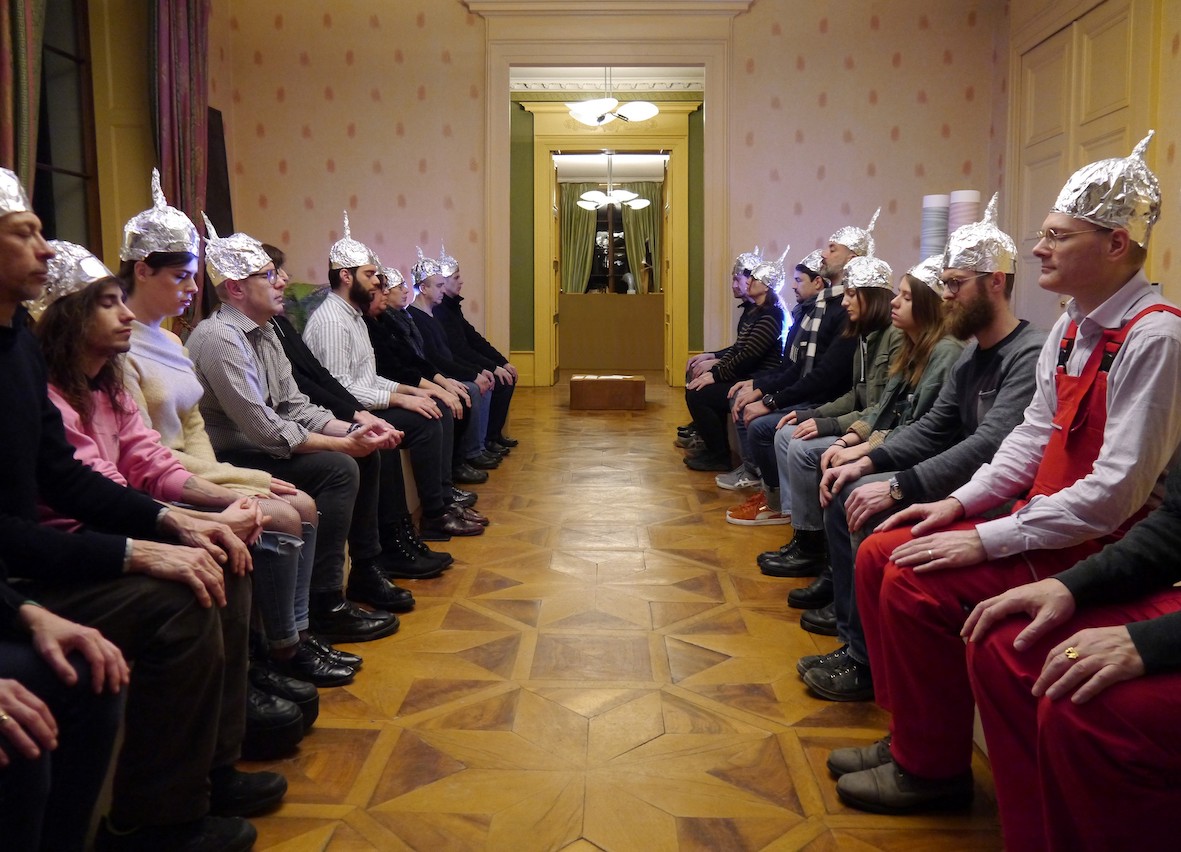
    Telepathie ist definiert als die Fähigkeit zu lesen, was im Kopf einer anderen Person vorgeht oder mit jemand anderem mental zu kommunizieren ohne Worte oder physische Signale zu benutzen. Es steht im Zusammenhang mit Begriffen wie Psychokinese, Sechster Sinn, Vorahnung, Weissagung, Telekinese und Teleästhesie. Eine Reihe von neuen ‚Technoceuticals‘, die technisch unterstütze Telepathie unterstützen, werden heutzutage schon verwendet, darunter invasive Neuroprothesen, Gehirn-Computer-Interfaces oder Neuronaler Staub.

    Im Kognitiven Kapitalismus wurde die Fließbandarbeit des Proletariats durch kognitive Arbeit am und im ‚World Wide Web‘ ersetzt, wo auf Plattformen unaufhörlich Daten produziert werden. Normale Touchscreens und Tastaturen sind dabei eher langsame und ineffiziente Mittel zur Interaktion mit einem Computer. Elon Musk gründete deshalb ‚Neuralink‘ um das Problem zu überwinden, was er für das Haupthindernis der optimalen Menschen-Maschine-Verbindung hält: Bandbreite. Musk erhofft sich durch den Einsatz von Gehirn-Computern-Interfaces einvernehmliche Telepathie für jeden zu möglichen; nicht zuletzt, um die geistigen Kapazitäten im Arbeitsumfeld zu intensivieren. Diese Gehirn-basierten telepathischen und telemetrischen Technologien, die unsere Gehirnwellenmuster in für Analysen offene Datenströme umcodieren, öffnen ein Fenster zu unserem Bewusstsein. In Folge wird etwas Ähnliches wie das, was Shoshana Zuboff in ‚Überwachungskapitalismus‘ als ‘Big Other’ bezeichnet hat, zunehmende Bedeutung im Sinne von totaler Kontrolle und Subjektivierung erlangen.

    Künstlerische Ansätze, die alternative Anwendungen telepathischer Praktiken jenseits der Optimierung von Arbeitskraft erforschen, haben das Potential, uns aus diesen zukünftigen Albträumen heraus zu experimentieren – vorausgesetzt wir haben den Willen das möglich zu machen.


    20.8.21, 17-21 h, Finissage and launch of the exhibition catalogue in form of a newspaper with texts on the topic  and a documentation of the entire show.

    31.7. and 4.8.21, 18-20h, performative lecture in the foyer: Warren Neidich, Performing the Parthenon Marbles Recoded

    with works by Kathryn Andrews, Simon Denny, Suzanne Dikker and Marina Abramović, Jacquelene Drinkall, David Horvitz, Agnieszka Kurant, Jonathan Monk, Gianni Motti, Lorenzo Sandoval, and Suzanne Treister.

    Telepathy is defined as the ability to know what is in someone else’s mind (or to communicate with someone mentally) without using words or physical signals. It is related to such notions as precognition, psychokinetics, sixth sense, premonition, augury, precognition, telekinesis, and telesthesia. A bevy of new technoceuticals that support technologically assisted telepathic capacity (such as brain–computer interfaces, cortical implants, bio neuro-headsets, and neural ‘smart’ dust) are already in use. Elon Musk created Neuralink to overcome what he considers to be the main obstacle to optimum human–machine interaction in communication: bandwidth. Touch screens and keyboards are slow and inefficient means to interact with a computer. However, “neural lace” and “neural dust” provides a much faster high-bandwidth interaction with which Musk hopes to make consensual telepathy possible for everyone by using brain-computer interfaces to intensify their mental capacities in the workplace. In cognitive capitalism, the proletariat working on the assembly line has been replaced by the cognitariat working on the World Wide Web using virtual platforms to create data. These new brain-based mediated telepathic and telemetrix technologies, which recode our brain wave patterns into data streams open for analysis and algorithmic jurisprudence, have opened a window into our unconscious. As such, what Shoshana Zuboff in Surveillance Capitalism has called the “Big Other” will take on added significance as a means of total control and subjectivization. Artistic practices engaged with telepathic practices by producing alternative uses beyond optimization in the workplace create the possibility to experiment ourselves out of this future nightmare—if we only have the will to think and act to make it possible.

    The project is supported by Haupstadtkulturfonds, and StediStiftung. The installation by Warren Neidich was made possible with funds from the Neustart program of the Stiftung Kunstfonds.


  • Maurizio Elletrico, An ephemeral banquet for the invisible guest: waiting for the bio-aristocrat

    Solo show, Site specific installations and new works inspired by the first volume of the saga written by the artist
    ‘The squirrel and the Grail’

    Curated by Chiara Valci Mazzara, Fondazione Morra resident curator and Susanne Prinz, Kunstverein am Rosa Luxemburg Platz

    Hosted by Kunstverein am Rosa Luxemburg Platz
    In collaboration with Fondazione Morra, Naples

    Maurizio Elettrico is a complex and erudite artist and writer. His saga in seven volumes – The Squirrel and the Grail – functions, on the occasion of his solo show, as the vessel through which his magical, irreverent, profane, philosophical, mythological referred and fantastic world is introduced to the public, drawing him into this all embracing installation: the world of Maurizio Elettrico’s saga coming true. The public is invited to experience this immersive landscape including an opera sound piece the artist conceived for the exhibition.

    The banquet for the invisible guest – consisting of a series of sculptural pieces installed on a banquet table surrounded by islands filled with astounding creatures and objects – also reminds us of more hospitable days.

    The menu of the banquet will be available, alas the courses remain invisible… as well as the guest: the bio aristocrat.

    Maurizio Elettrico ( Naples,1965) lives and works in Naples. After his studies in natural sciences, he focused his artistic research on the interdisciplinary relationships between philosophy, history and iconography. His artistic practice is characterised by the variety of materials he uses and the lexicon that he applies, ranging from freehand drawing on fine art paper or fabrics to various media including sculpture, installations realised with recovered materials, video, performance and writing. Elettrico re-invents the world into a new mythological reality where the radical secularisation of the sacred and science-fiction combine and where the distance between sense and nonsense is shortened so that their theophanic nature would become clearly deduced. The recovery of dissonant forms and materials opens the way to a magical world of medieval ancestry, organised according to a mysterious and ideological taste for alchemy, producing a visual pantheon that dissolves itself into a junction of intelligence, artistic creation and technological knowledge. He has had numerous exhibitions in Italy and abroad, working with some of the most recognised contemporary art curators like Jan Hoet, Lorand Hegyi and Achille Bonito Oliva. He started his career in Naples, with a solo exhibition at Vera Vita Gioia’s Gallery in 1993. His hometown has been a point of reference throughout his career, as shown by his ongoing collaboration with Fondazione Morra, where his works are included in the permanent collection and where his artistic practice is developed and promoted. He started working abroad when the SMAK in Ghent (Belgium) acquired various pieces to be included in its permanent collection in 1997. In 2004, Edizioni Morra published The New Empire, a volume presenting a series of imaginary scenarios, revealing to the public Elettrico visions about alternative future worlds. Shortly after he produced a large-scale installation at the Padova Charterhouse and exhibited in Quadriennale di Roma at GNAM. In 2006 he presented his solo show Lo Scoiattolo e il Graal (The Squirrel and the Grail) at the Capodimonte Museum where he presented the characters from his book The New Empire. In 2007 he presented the exhibition Cervandro – Il Nudo travestito (Cervandro, the Nude in disguise) at Arte Contemporanea Pio Monti in Rome, and right afterwards a further solo show at Lipanje Puntin Gallery in Trieste. In 2009 he presented his work at the Venice Biennale – Arsenale- and the Knokke Biennale in Ghent in collaboration with Hoet Bekaert Gallery. In the same year, his volume L’Infante demiurgo was published with Mimesis Edizioni, Milan 2009. In 2011, he participated for the second time at the Venice Biennale, and in 2013 at the multimedia exhibition Biorema at Paola Verrengia Gallery in Salerno. Since 2009 he has been working on a saga developed in seven volumes Lo Scoiattolo e il Graal (The Squirrel and the Grail). In 2015, Elettrico presented Cibum Deorum, a large scale sculpture, as part of the exhibition L’Albero della cuccagna, Nutrimenti dell’Arte, curated by Achille Bonito Oliva and presented throughout Italy. In 2016, he had a solo exhibition at PAN Museum of Naples , Historia Supernaturalis, curated by Eugenio Viola

  • Declan Clarke, The Museum of Broadcasting and Loneliness

    Declan Clarke, The Museum of Broadcasting and Loneliness

    Language: Englisch
    Size: 210 x 148 mm
    Page: 52
    Format: Brochure


    Artists: Declan Clarke

    @ The Museum of Broadcasting and Loneliness
    © all images: The Paddy Clarke Archive

    published by
    Verein zur Förderung von Kunst und Kultur
    am Rosa-Luxemburg-Platz e.V. / Susanne Prinz

    4 Euro to cover postage